
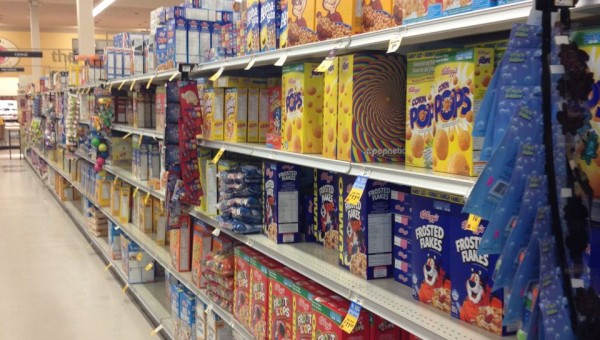
Ok. The cat has been out of the bag for some time in my family but boxed cereal is OUTLAWED in my house. As if I needed more reasons to hate the stuff, I got a brand new list when I heard the University of Manitoba’s head of Food Sciences lecture: What’s in Your Cereal Bowl? The Good, The Bad and The Ugly.
“From sugary loops to bran flakes and raisins, the breakfast cereal industry is a multi-billion business that takes up entire aisles of the supermarket. That bowl of cereal you ate this morning was grown by farmers, developed by food scientists and nutritionists, processed by large food companies and promoted by marketing professionals. Learn about food processing secrets, the truth about health claims and how to make good choices when it comes to breakfast.”
First of all, I’m going to say straight up that I believe there is a special place in H-E-Double-Hockey-Sticks for marketers and companies that target vulnerable, rushed, and uninformed parents with health claims , like “A good source of fibre” or “Made with whole grain” on their trashy cereals. That’s not even touching the fact they use cartoon characters, athletes and toys to specifically target children (btw- you can empower your kids to recognize and resist marketing).

Gary Fulcher speaks to a full house eager to learn what's in their breakfast cereal.
Gary Fulcher is the head of Food Sciences at the University of Manitoba and a former General Mills employee.
His talk kicked off a new lecture series. This is where I’ll admit I was tempted to leave about as quick as I arrived. That’s because once I looked around, I realized the series was being hosted by the University’s agriculture department, and the U of M has a long and convoluted relationship with Monsanto. I thought FOR SURE we were going to hear alot about the great things cereal grains and technology could do for people’s health and for cash-strapped farmers looking to move up the value chain…
While Fulcher WAS careful not to outright condemn processed, boxed cereal, (I’m guessing maybe he had received a word of caution from the university’s PR team- several of which hovered nearby throughout the talk), he did manage to share several things that would lead most logical folk to toss it- or at least START questioning what’s in their bowl.
He talked about the plethora of health problems- obesity, heart disease, diabetes, that have arisen as the world increasingly turns to highly-processed convenience foods which almost always include boxed or instant cereals for breakfast.
Fulcher compared his own childhood breakfast- which consisted of a daily bowl of old fashioned oatmeal, “the kind that takes 10 days to cook and after you eat it you’re not hungry for 3 days”, to the highly-processed, high-glycemic, puffed, and sugar-laden cereals that line the shelves of supermarkets today.
The cut-throat world of multinational food giants
The value of hearing from someone who spent time ‘on the inside’ always lies in their willingness to truthfully share what they have seen. For Fulcher, that included things like the ‘disgust’ of executives at General Mills when their chief competitor, Kelloggs decided to hawk Frosted Flakes to kids using the now infamous cartoon cat, Tony the Tiger.

“They said they would never pull the same crap.” Fulcher said, noting the lineup of General Mills now includes such quality products as Lucky Charms, Trix and Count Chocula…
Cereal manufacturing: what really happens
So what happens before that cereal makes it to your bowl?
Grains today are basically ‘mined’ Fulcher said. The germ and the bran - which contains all the oils and fat is stripped off because products are tougher to keep shelf stable when they contain oil.
“All the good stuff is basically thrown away or fed to animals,” Fulcher said.
That almost nutrient devoid portion is further processed before it is made into the flakes or puffs that wind up on the nation’s breakfast tables.
Because you now have a nutrient-deficient product, food manufactures then ‘fortify’ - or add back ‘pixie dust’ — synthetic vitamins and mineral in place of the ones that were stripped out.
“You would never eat cereal again if you went through the place where the fortification happens,” Fulcher noted.
But he talked about other tricks of the trade too. Like, how it’s possible for raisins to be soft and chewy and flakes crispy and dry inside the same box? Well, it’s simple, Fulcher said. You take the water out of the raisin and replace it with something that doesn’t evaporate as easily. That something is glycerin.
*While glycerin is traditionally made from natural sources like lard and tallow, it is also a main by-product from biodiesel production, according to author Rami Nagel.
Bottom-line driven
Of course, it almost goes without saying that everything is run on a profit margin basis. That’s why cereals are puffed full of air and water (they’re cheaper to produce and ship that way). Just compare a box of Sunny Boy (a collection of grains like flax and rye) or a bag of steel cut oats to a box of Fruit Loops or Corn Flakes.
Extruders- the huge machines that push out the cereal, cost food manufacturers big money but it’s a small overall price to pay, Fulcher said, because they can pump out product around the clock without being serviced for as long as a year. He also noted that they could fill an entire room with extruded cereal in just a few minutes…
What ‘primitive’ cultures knew
I was really happy Fulcher acknowledged that primitive cultures knew how to increase the digestibility and unlock vital nutrients in their grains.
He gave the example of South American Indians who soaked Maize in ash and lime to unlock nutrients like niacin (Vitamin B3), which is completely inaccessible otherwise. This helped the population avoid Pellagra - something that afflicted cultures eating the same grains (exported by Columbus, for example) sans the accompanying critical preparation techniques.
So what now?
Judging by some of the questions that came up, it seemed many people there was eager to have their favourite breakfast cereal absolved - or at least for Fulcher to recommend a GOOD ONE. The sad truth is, boxed cereal is not a food anyone should be eating. There are plenty of other QUICK AND EASY real food breakfasts that will build your health, not tear it down.
“I wouldn’t recommend eating cereals for breakfast at all,” Fulcher said, instead..ignore what you’ve heard about cholesterol “and eat some eggs.”
How is cereal made anyhow? Check it out here although it doesn’t show the ‘mining process’ of stripping apart grains like wheat. (p.s. watch for the pixie dust (or vitamin fortification) being sprayed about half-way through.)